













EDGE was founded 10 years ago by two former Gleeds employees. Now the consultancy is going through a management buy-out and targeting rapid expansion while trying to stay true to its SME roots. Carl Brown finds out more
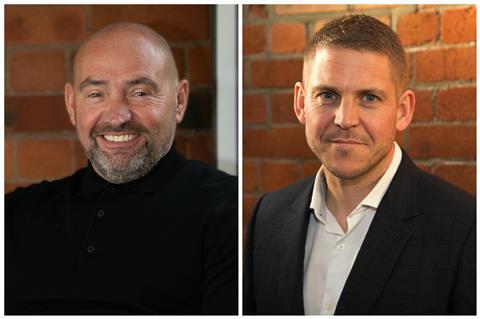
“The short answer is I am better at adding up then drawing,” laughs Matt Hill, explaining why he did not pursue a career in architecture despite studying the subject at Liverpool University. “I’m not creatively minded. I’m more scientifically and numbers-minded.”
Hill accordingly switched his focus by doing a construction management master’s at Sheffield Hallam University. Fast-forward two decades and numbers are certainly at the forefront of his mind as he prepares to become managing director of the EDGE consultancy in July of next year.
The fast-growing firm is expecting to report turnover of around £22m in the year to 30 June 2025, which would represent an increase of 50% year on year. It is then aiming to increase turnover by 20% each year after that.
The consultancy, which celebrated its 10th anniversary last month, will – if all goes well – be owned by Hill and several other partners following a vendor-initiated management buyout next year.
Director Hill, along with Lee Simmonite, one of the firm’s two co-founders, sit down with Building in EDGE’s Moorgate office in the heart of the City of London to talk about the plans for growth.
We start by going back to 2016, when EDGE was founded in Nottingham by Simmonite and Nick Phelan, both former employees of consultancy giant Gleeds.
EDGE (not to be confused with the Dutch developer of the same name) was originally focused on cost management, before increasingly providing project management, building surveying and advisory services. Simmonite says the firm was set up to provide a more hands-on, personal service to clients.
We have very, very senior hands-on professionals delivering services with a very lean support function
Lee Simmonite, EDGE co-founder
“We had grown up in a corporate where you would go in, win the project, and then you get the graduate delivering it – and then that client satisfaction is not always there,” Simmonite says.
“So we really took it back to basics… We have very, very senior hands-on professionals delivering services with a very lean support function.”
Initially the firm focused on health and industrial manufacturing, with some housing. Nowadays it operates across 18 sectors.
EDGE in numbers:
£22m Projected turnover in the year to 30 June 2025
£14.4m Turnover in the year to 30 June 2024, according to accounts
160 Number of employees
7 Number of offices (including a “satellite” office in Newcastle)
£2.1m pre-tax profit in the year to 30 June 2025
18 Number of sectors in which it now operates
It opened its sixth office in Cambridge last month (excluding a satellite office in Newcastle) and now employs 160 people, with more growth planned.
The big aforementioned change comes next year, when Simmonite and Phelan sell their stake and depart the business. They have already moved in this direction.
Since 2020, the firm has operated an employee benefit trust (EBT), with Simmonite and Phelan owning a third each and a group of 12 employees including Hill owning the other third. From July 2027 several members of the 12 (neither Hill nor Simmonite will reveal how many for confidentiality reasons) led by Hill will buy out Simmonite and Phelan’s stake and Hill will become the managing director.
The focus is therefore on Hill and his plans for the rejigged business.
The plan for growth
EDGE may work across 18 sectors but, as Hill says, two-thirds of its income comes from five key sectors, namely health, education, housing, infrastructure and aviation.
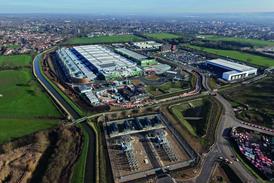
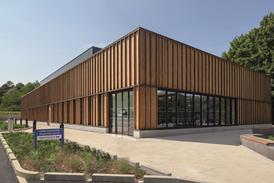
Projects include work on the National Rehabilitation Centre in Loughborough, Leeds Bradford Airport expansion, rolling out all-weather pitches for the Football Foundation, cost management for supermarket chain Aldi on 14 new stores, work for carehome provider McCarthy Stone and for Sheffield Housing Company – a joint venture which consists of housebuilder Keepmoat and Sheffield council.

The key is to maintain these footholds while pushing into emerging areas, such as retail, leisure, culture and heritage, defence and manufacturing.
Regionally Cambridge is an area the firm is looking at closely – hence its decision to open an office there – as it is expecting to grow through life sciences and housing.
“We have relevant experience in labs, advanced manufacturing, office, commercial fit out. That’s part of the attraction in Cambridge,” says Hill.
EDGE has two major healthcare projects in the region also, including work on the redevelopment of Hinchingbrooke Hospital in Huntingdon and providing cost management services for the new Cambridge Children’s Hospital.
“We need to resource up to deliver those schemes as they’re now picking up momentum,” says Hill. ”That was the catalyst for us to say, ‘let’s have a look at Cambridge’… There were a lot of synergies with our sector specialisms, so that’s why we’ve got our first recruits in there working, and we’re going to be very quickly expanding in that region.”
Another area of potential geographical growth is the North-east, where the firm already has a satellite office, along with the North-west and South-west. In Scotland it has work on defence schemes. “We’re looking at having, you know, eight to 10 offices quite easily,” says Hill.
When we look at the optimal model for EDGE, we feel that having more of a balance between project management and cost management discipline is where we’d like to be
Matt Hill, incoming managing director, EDGE
In terms of split by discipline, EDGE has been rebalancing, with cost management services making up about 60% of its business now, compared to 80% a few years ago. It is increasingly doing project management work, which Hill says is part of its drive to become more “agile and adaptable”.
He adds: “We are quick to respond, quick to make decisions and lean into opportunities. When we look at the optimal model for EDGE, we feel that having more of a balance between project management and cost management discipline is where we’d like to be.”
This shift is also due to the firm winning more work through frameworks as opposed to one-off repeat business. Hill says: “We are doing projects with a greater longevity of income, which is leading to a shift in terms of being more project management led. There’s also a call for multi-disciplinary teams.”
Hill, who also started out at Gleeds as a QS in 2004 and joined EDGE soon after it was founded in 2016, sees opportunities to grow the building surveying business, which currently accounts for around 10% of turnover.
“We’ve got lots of clients that have got huge estates, so utilising those connections with our building surveying offer in terms of retained estate work, regular project, DDA compliance, whatever it may be, retrofitting with decarbonisation, and then advisory services in key sectors [also], is a good growth opportunity,” says Hill.
While he talks big on growth, Hill also stresses that EDGE will turn work down if it cannot come up with a delivery model that works because it “won’t chase the turnover”.
He says the company has a “robust bidding process.”
Hill fires off the considerations in his soft Yorkshire accent: “We put a real focus on not just ‘what’s our chance of winning?’ but also ‘how are we going to deliver it?’
“How are we going to maintain our reputation? Are we going to be exposed? Who’s got the right capability? Have we got the skills and the capacity? Have we got the relationship as well?”
When pushed however he says EDGE may be more willing to take on work in growth regions to establish itself – but only if it feels it can.
EDGE’s growth is prompting it to look at data and it is using digital tools to “give more accurate, predictive, sort of consistent outcomes, the outcomes for customers.”
This includes the development of EDGE’s own “in-house AI agent”, which Hill says is “designed to automate processes, increase speed and responsiveness, and deliver deeper insights and analytics”. He adds that this will be rolled out across the business.
“This can be more challenging for larger international organisations, where specialist expertise is often concentrated within individual teams rather than embedded more widely across standard business practices.”
The operating environment
We move on to talk about Hill’s biggest frustrations about the current operating environment which may be making it harder for the construction industry to deliver. He talks about planning issues and changes to government policy.
“It’s stalling programmes, it’s delaying timelines, it’s stalling funding decisions,” he says. “And, you know, that’s frustrating particularly while you’re working in certain public sectors.”
More specifically he says that large public infrastructure initiatives can sometimes involve a “complex and resource-intensive” setup.
He says that greater efficiency might be achieved by allocating funding and responsibility more directly to end-user clients, allowing them to focus on delivery rather than navigating “extensive programme-level requirements” that can add cost and time. With established standardised designs and delivery approaches already available, a more streamlined approach at the outset could help ensure public investment is focused where it delivers the greatest impact, he says.
Retaining an SME feel
Perhaps the bigger challenge for EDGE is how it retains its personal, “hands-on” service as it expands.
We like the SME feel, keeping each office to no more than about 40 or 50 people. It means people still have accessibility to the leadership
Matt Hill
“We like the SME feel, keeping each office to no more than about 40 or 50 people. It means people still have accessibility to the leadership, who understand what’s happening,” Hill says.
The accessibility of the bosses to employees is part of a culture that empowers staff to grow their skills and develop, says Hill, who speaks with pride about EDGE’s culture.
Simmonite points to the social side – the company takes staff skiing every year – as evidence of a good culture.
When it comes to recruitment, Hill says EDGE prefers to recruit people who have on-the-job practical experience, through for example apprenticeship degrees. “We know when they come out of the degree, they are a lot more rounded, they understand construction… Otherwise you just get a graduate and they are really green.”
Finally Building asks about the prospect of EDGE being approached by larger firms for acquisition in the future. Would Hill and his fellow partners be tempted to sell up?
He suggests not, saying the firm’s USP is that it is smaller with a personal service. “If you look at a lot of the companies that have been consumed, their identity is gone within two or three years” he says. “There’s people leaving, a mass exodus.”
He sees an opportunity for EDGE to recruit these disgruntled employees. He also stresses that he has been there from the start and has a personal connection with the company. He hopes eventually to pass the baton on to the next person.
Hill has come a long way since his epiphany that architecture was not the best profession for him. As a construction professional he looks set to have a few interesting years as he attempts to spearhead growth at EDGE while keeping the hands-on personal service he believes has been so crucial to its success to date.







No comments yet