















Owen Dannatt talks Liverpool Street, planning hold-ups and turnover. Just don’t call the firm a concrete contractor, he tells Dave Rogers
“We don’t build a lot of kilns but we certainly build a lot of bridges.”
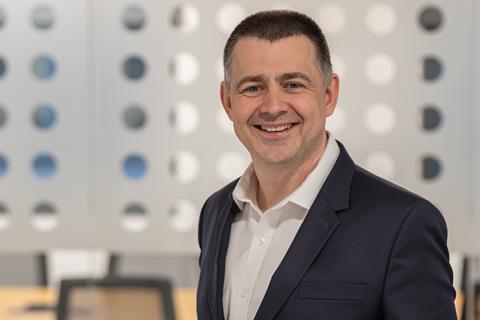
Kilnbridge chief executive Owen Dannatt is a bit stumped. He is not sure how the Kilnbridge name originated. He had heard that it was the amalgamation of two villages in Ireland but, like most of these things, is a bit unclear about the exact detail.
It turns out, in fact, that the name is not dervived from Irish villages or ancient family surnames but was instead chosen to reflect the firm’s Irish roots and also be a nod to what the firm wanted to build, namely heavy structures and infrastructure.
The company was set up in 1992 by brothers Dermot and David McDermott. Its first office was a former modular building at Canary Wharf no longer needed by its previous owner and it initially specialised in the smaller work larger subcontractors tended to overlook after the firm spotted a gap in the market.
Over time, younger brother Dermot eventually became the face of the company – David having retired in 2007 – and two years ago Kilnbridge brought in its first chief executive, with Dermot becoming executive chairman.
Dannatt was lured from developer Sellar where he had spent close to five years as chief operating officer. His arrival at Kilnbridge marked a return to his civil engineering roots – he graduated with a civil engineering degree from Imperial College – having started out at Taylor Woodrow nearly 30 years ago, before leaving for spells at Deloitte and the Qatar National Bank, where he was that country’s eyes and ears for its investment in the Shard.
With so many industry leaders having a QS background, Dannatt says: “Having that [civil engineering degree] is a good match for this business. We are a very engineering-led business. Everything we do is engineering. The thread of engineering that runs through [Kilnbridge] is critical.”
At Sellar, his brief included Paddington Square, built by Mace, the beginnings of the 60 Gracechurch Street scheme, now starting to get going and due to built by Bovis, and the Liverpool Street station redevelopment.
He admits that the Liverpool Street application process was a difficult time. In short, the scheme Sellar was promoting for Liverpool Street had been drawn up by Swiss architect Herzog & de Meuron. It involved putting an office block above the listed Andaz hotel in order to fund the wider redevelopment of a station bursting at the seams.
But the proposals received so much opposition that it was eventually withdrawn by Network Rail in favour of an alternative by Acme. That scheme, too, received an awful lot of opposition but was overwhelmingly passed for planning by the City of London in February,
Dannatt, who turned 46 last December, gives the impression that he found the whole process extremely frustrating and very exhausting. “It’s a fair assessment to say the planning environment [in this country] is challenging,” he says.
“We need to learn some lessons from what happened at Liverpool Street station, to support those private developers who are trying to use private money to the benefit of the public purse and not let things play out like they did.”
As things at Liverpool Street got more and more bogged down, an old friend from his Taylor Woodrow days got in touch to let him know Kilnbridge was looking for a chief executive. “Things were starting to slow down in the London market,” he says. “I met Dermot and the whole process [to get the job] took about four months.”
Dannatt is fond of saying this about Kilnbridge: “We are the UK’s leading structures specialist.” He adds: “We deliver engineering excellence and innovative solutions.” Call them a concrete frame specialist at your peril.
On that, he says, Kilnbridge is not especially interested in competing for bog-standard structures. “If our involvement was a pretty standard concrete frame, there are plenty of others who can do that. Where we can add the value and point of difference is if it’s unusual shapes, unusual configurations.”
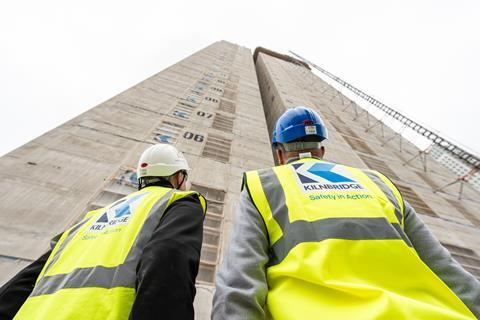
One of the Kilnbridge jobs of which he is most proud is the Colne Valley viaduct, the longest structure on the route of the HS2 railway between London and Birmingham.

Kilnbridge delivered the reinforced concrete foundations, piers and associated precast elements that form the viaduct’s primary load-bearing system. “You can make concrete beautiful,” he says and the firm’s experience on the structure is helping it with the AHMM-designed Lansdowne House scheme being built by Mace for developer CO-RE at Berkeley Square in central London.
“It’s got a lot of architectural concrete on it and the quality and technology developed through Colne Valley is being used there.”
HS2 accounts for around 30% of Kilnbridge’s workload right now and its main focus, after Colne Valley, has been its work at Old Oak Common, the new station being built by a joint venture of Balfour Beatty and Vinci.
Like many, Dannatt thinks the line has to end up at its original destination at Euston in the middle of London. “They can’t stop it where it is, surely,” he says.
An impending government review of the scheme is expected to be sharply critical of the way that costs have ballooned and how contracts were negotiated. But Dannatt says no contractor would have been able to fix a price on a scheme building a 140 mile-long railway.
“You don’t know what challenges you’re going to come across in the ground. With the best will in the world, you can’t fix a price unless the design is complete and you do all the ground investigations. But to do all of that would take so long…”
His voice tails off but the inference is clear: the scheme would never have got started if all that had happened.
He says HS2 has suffered from a fractured planning system – like the one that dogged Sellar at Liverpool Street.

Planning authorities up and down the line, he says, were given the power to sign off changes. Vested interests were empowered as a result, he adds.
“There is inherent uncertainty in that. Contractors can take construction risk but they can’t take political risk in a construction context.
“Clarity would be very good for organisations at our level. It’s very hard to plan workloads when the biggest contract in the business is fluctuating up and down.”
While HS2 is its single biggest scheme, Dannatt says Kilnbridge has spread itself across several sectors as markets flex.
Its central London building market is still core and, as well as Lansdowne House, the firm is on site with a scheme at Canary Wharf called One North Quay. This is a new 23-storey life sciences building being developed by Kadans.
Kilnbridge made its name at Canary Wharf and its roll call of jobs at the Docklands estate includes 25 Bank Street, Churchill Place and One Canada Square. But Dannatt says the firm is increasing its national footprint with offices in Runcorn, Birmingham and Ipswich as well as its main base in Canning Town.
It also has a steel factory in Northampton, a rarity for a firm best known for its work in concrete. Dannatt says Kilnbridge is never going to compete against the traditional big two, Severfield and William Hare, but reckons around 20% of its business is with steel.
It has fabricated around 1,000 tonnes of steel for a new baggage hall mezzanine going in at Heathrow airport but, again, Dannatt says it wants to be a point of difference. “We’re not going to compete for sheds, there are plenty of players in the market that can do that. Where we add the value is the unusual shapes and configuration.”
He adds: “The landscape has changed from heavy demolition and rebuild to repurpose. You don’t know what you’re going to find when you open up these buildings. We can do our own surveying, concrete repairs, we fabricate steelwork on site. It cuts out so many interfaces for building owners.”
When Dannatt joined, Kilnbridge’s turnover in the year to June 2024 was £86m. That was a fall from the £120m posted the year before which, the firm said, was down to cancelling phase 2 of HS2 and some commercial schemes being stalled.
Revenue in its latest financial year, Dannatt’s first full one in charge, recovered to £129m with pre-tax profit up more than 80% to £6.7m. Dannatt says for its current financial year the number will be closer to £200m.
In its last results it saw £349,000 distributed to all eligible employees in the fourth and highest profit‑share payment since transitioning to an employee‑owned group in March 2021.
As well as infrastructure like roads and rail, buildings such as offices and life sciences, Kilnbridge is also involved with energy such as nuclear, transmission and wind. “We are gearing ourselves up for substantial growth,” Dannatt says. “We are not going to peg ourselves to a particular number.
“There is lots of work in the infrastructure space. Data centres are a growth area for us. Water as well.”
It is clear that the revenue figure will be a lot more than £200m in the long run and that Kilbridge’s current employee number of 480 will go up. “There is a lot of recruitment going on,” he says.
But for now, Dannatt remains coy. “We will be the size the market needs us to be.”
From Imperial College to Kilnbridge (via the Shard): Owen Dannatt’s career so far
Owen Dannatt started his career working for Taylor Woodrow, having been sponsored by the firm as a student. He graduated from Imperial College in 2002 and, while he was there, led a trip for Imperial’s undergraduate engineers to look at work being done on the leaning tower of Pisa in Italy.
Once he graduated, his jobs at Taywood included a new stand at West Ham United’s old Upton Park ground but it was at the redevelopment of King’s Cross station – building a new ticket hall as part of the arrival of HS1 at the nearby St Pancras station – where he cut his engineering chops. “It was a really good job to be on,” he says.
He left Taywood in 2007 for a career in the business of construction, first with Deloitte, where he spent three years working on corporate finance at its real estate arm, and then at Qatar National Bank (QNB), where he was the investor’s eyes and ears for its interest in the Shard. QNB was part of the Qatari consortium that helped to fund the scheme and get it out of the ground.
He worked with the developer Irvine Sellar and remembers: “He certainly was a character. I had a very good relationship with Irvine.” He ended up joining Sellar in 2018, a year after Irvine passed away, and stayed until 2024.
But he needed a new challenge, having been worn down by the impasse on its Liverpool Street station development and the general slowdown in London commercial. “You could see the broader market was going to be tougher.”
An old Taywood colleague tipped him off about the Kilnbridge role and he arrived nearly two years ago.
He says he can see Irvine Sellar’s entrepreneurial spirit in Kilnbridge founder Dermot McDermott who, while not involved day-to-day, stays in touch. “He keeps his finger on the pulse, he knows what’s going on but he leaves me to get on with it. He has been very good at enabling me to run the business as I need to.”
Married with three children aged 12, 10 and eight, Dannatt spends much of his working week away from his Windsor home, coming back at weekends. He thinks he ended up in construction because his own dad was a metalwork teacher in Dorset where he grew up.
Above all, he still loves being on a site. “I have this inherent love of the industry and building things.”
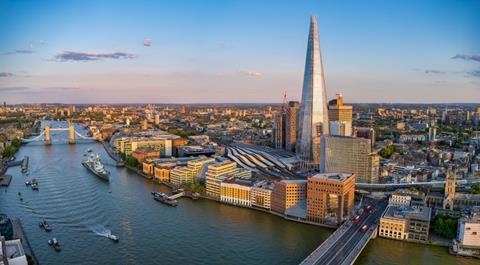
So what’s his favourite building, then? “It’s got to be the Shard hasn’t it?” It’s not just because he worked on it, he says, but because of what it symbolises.
“It’s a beacon for what a modern London is. It respects the context of the station [London Bridge] and has unlocked all that upgrade work to the station and surrounds. It’s a landmark for the world.”






No comments yet