













Leaders at the final 2025 Building the Future Think Tank regional roundtable in Cardiff warned that Wales’ push for affordable, low carbon homes risks stalling unless policy, funding, infrastructure and skills are better co-ordinated. With ambition in place, the challenge now is turning strategy into delivery
”The ambition is there in Wales,” said Catherine Griffith-Williams, chief executive of Construction Excellence in Wales, “but ambition on its own doesn’t deliver homes.” That observation framed the final discussion in the 2025 Building the Future Think Tank regional roundtables tour, run in partnership with Constructing Excellence, Gleeds and Fenwick Elliott.
Held in central Cardiff and chaired by Building deputy editor Carl Brown, the session brought together public and private sector leaders to examine how Wales can accelerate the delivery of affordable, low carbon housing while navigating land constraints, rising costs and increasingly complex policy demands.
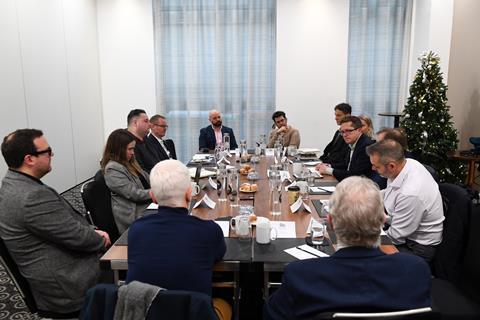
Wales faces a well-documented housing crisis. Demand for affordable and social housing continues to outstrip supply, even as the Welsh government targets 20,000 new low carbon homes for social rent by 2026. At the same time, national commitments to net zero by 2050, reinforced through planning policy and building regulations, are reshaping expectations around how homes are designed, built and retrofitted.
“When policy, planning and infrastructure move at different speeds, it becomes much harder to invest at scale.”
Cenydd Rowlands, property director at the Development Bank of Wales
What emerged from the discussion was not a lack of intent, but a growing concern that fragmentation across planning, funding, infrastructure and delivery is slowing progress at precisely the moment greater co-ordination is required.
Pressure on delivery from all sides
There was a clear sense around the table that public bodies are being asked to deliver more, faster and to a higher standard, often without funding, land or procurement models aligning with that ambition.
Rising costs were repeatedly cited as a major constraint. Shane Jay, project director at Lovell, warned that viability is becoming increasingly fragile. “Material inflation hasn’t gone away,” he said. “When you combine that with higher sustainability standards, schemes can tip very quickly from viable to undeliverable.”
That pressure is felt particularly acutely in affordable housing, where margins are already tight. Stuart Jones, regional development director at Wates Group, noted that while the sector is committed to low carbon delivery, cost certainty remains elusive. “We all support the direction of travel,” he said. “But we need mechanisms that recognise the additional cost and risk being pushed into schemes.”
From a funding perspective, Cenydd Rowlands, property director at the Development Bank of Wales, stressed that certainty is critical. “Developers and housing providers need confidence,” he said. “When policy, planning and infrastructure move at different speeds, it becomes much harder to invest at scale.”
Around the table
| Chair: Carl Brown | Deputy editor | Building |
| Andrew Dobbs | Director | LiteSteps Consulting |
| Mike Edmonds | Director of construction management consultancy | Altmore Partnership |
| Catherine Griffith-Williams | CEO | Construction Excellence in Wales |
| Mark Harris | Planning and policy adviser for Wales | Home Builders Federation |
| Shane Jay | Project director | Lovell |
| Stuart Jones | Regional development director | Wates Group |
| Cenydd Rowlands | Property director | Development Bank of Wales |
| Andy Sutton | Co-founder and chief innovation officer | Sero |
| Jake Thompson | Property programme manager | Cardiff Capital Region |
| Simon Tolson | Partner | Fenwick Elliott |
| Chris Wheeler | Regional land and development manager | Willmott Dixon |
Planning, land and the limits of policy
Planning policy was a recurring theme throughout the discussion. Mark Harris, planning and policy adviser for Wales at the Home Builders Federation, argued that the system is struggling to reconcile national ambition with local delivery. “Future Wales sets out a clear vision,” he said, “but translating that into allocated, viable sites on the ground is still incredibly difficult.”
Land constraints were highlighted as a particular issue in urban areas. Chris Wheeler, regional land and development manager at Willmott Dixon, said that unlocking sites often depends on infrastructure that sits outside individual schemes. “We see opportunities that can’t move forward because transport, utilities or schools aren’t in place,” he said. “Without that wider investment, housing delivery stalls.”
Rowlands added that uncertainty around timescales undermines confidence. “Delays create risk,” he said. “That risk feeds directly into cost and appetite to invest.”

Sustainability targets meet delivery reality
Alongside housing numbers, the push for net zero carbon is reshaping expectations across the sector. Andy Sutton, co-founder and chief innovation officer at Sero, argued that Wales has an opportunity to lead on low carbon housing if delivery models evolve. “We know how to build homes that perform better,” he said. “The challenge is scaling that approach affordably and consistently.”
Retrofitting existing stock was identified as one of the biggest hurdles. Sutton noted that much of Wales’ housing pre-dates modern energy standards. “New-build is only part of the picture,” he said. “If we’re serious about net zero, retrofit has to move from pilot projects to mass delivery.”
However, Mike Edmonds, director of construction management consultancy at Altmore Partnership, cautioned that retrofit brings significant risk. “The technical challenges are real,” he said, “but so are the commercial ones. Without clear funding and procurement routes, confidence is hard to build.”
Modern methods and supply chain resilience
Modern methods of construction were widely discussed as part of the solution, but not a silver bullet. Jay emphasised the importance of context. “MMC can absolutely help,” he said. “But it has to be the right solution for the site, the client and the end user.”
Supply chain resilience emerged as a parallel concern. Jones warned that increased demand for low carbon components could expose weaknesses. “If everyone moves at once, the supply chain has to be ready,” he said. “Otherwise, delays and cost escalation undermine the benefits.”
From a regional perspective, Jake Thompson, property programme manager at Cardiff Capital Region, highlighted the need for long-term thinking. “We need to look at skills, manufacturing capacity and infrastructure together,” he said. “Housing doesn’t exist in isolation.”
Capacity, skills and delivery confidence
Beyond policy and funding, several contributors highlighted capacity as a quieter but equally pressing constraint. The demand for affordable, low carbon homes is rising at a time when the sector is grappling with skills shortages and stretched local authority teams. As one participant observed, even where funding and land are available, the ability to mobilise projects at pace cannot be taken for granted.
Jones noted that delivery confidence is becoming a differentiator. “Clients want certainty,” he said. “They want to know not just that a scheme meets policy, but that it can actually be built, on time and to the required standard.” That confidence, he suggested, depends on early engagement across planning, design, construction and operation.
Jay agreed, pointing out that late-stage changes driven by sustainability requirements can undermine programmes. “If low carbon strategies are bolted on late, they create risk,” he said. “If they’re embedded early, they become much easier to manage.”
What are the Built Environment Missions Statement and Digital Action Plan for Wales?
The Welsh government’s Built Environment Missions Statement sets out a shared vision for the nation’s construction and property sectors, focusing on decarbonisation, productivity, social value and collaboration. It aims to align public and private sector activity around common outcomes and reduce siloed working.
The Digital Action Plan for Wales supports this ambition by promoting consistent use of digital tools and data across the built environment. Its focus includes improving information-sharing, enabling better decision-making and supporting modern construction methods.
Together, the two frameworks seek to create a more co-ordinated, efficient and transparent construction ecosystem. As highlighted during the roundtable, their success depends on adoption at project and organisational level.
That need for early alignment was echoed by Edmonds, who argued that procurement models must evolve alongside technical ambition. “We still procure many projects in ways that discourage innovation and collaboration,” he said. “If we want different outcomes, we need different behaviours from the outset.”
From a funding perspective, Rowlands returned to the importance of scale. “Small, fragmented schemes are harder to finance and harder to deliver,” he said. “There’s an opportunity in Wales to think more strategically about pipeline and aggregation.”

Thompson added that regional collaboration could play a larger role in building that pipeline. “When local authorities work together, they can create programmes that justify investment in skills, manufacturing and infrastructure,” he said. “That’s where momentum starts to build.”
What linked these points was a shared concern that, without sufficient capacity and co-ordination, even well-designed policy risks underperforming. As Griffith-Williams put it, “Delivery is where ambition is tested. If we don’t strengthen the system around it, the pressure will keep falling on individual projects.”
The challenge of silos
Despite shared goals, participants repeatedly returned to the problem of siloed working. Griffith-Williams described fragmentation as one of the biggest barriers to progress. “We have strong policy and committed organisations,” she said. “But too often they operate in parallel rather than together.”
That concern was echoed by Simon Tolson, partner at Fenwick Elliott. “When responsibilities are unclear, disputes become more likely,” he said. “Alignment reduces risk for everyone.”
“Delivery is where ambition is tested. If we don’t strengthen the system around it, the pressure will keep falling on individual projects.”
Catherine Griffith-Williams, chief executive, Construction Excellence in Wales
Several participants referenced the need to align delivery with the Built Environment Missions Statement and the Digital Action Plan for Wales, both of which aim to improve co-ordination across the sector. While these frameworks set a clear direction, their impact depends on consistent adoption at project level.
Infrastructure as the missing link
Infrastructure was repeatedly described as the key to unlocking housing supply. Wheeler argued that without upfront investment, even allocated sites struggle to progress. “Housing follows infrastructure,” he said. “If that investment doesn’t come first, delivery slows down.”
For Thompson, regional collaboration is essential. “Local authorities, developers and infrastructure providers have to plan together,” he said. “Otherwise we keep solving the same problems scheme by scheme.”
From ambition to action
As the discussion drew to a close, the focus shifted from diagnosis to delivery. Edmonds summed it up succinctly: “We don’t need more strategies. We need to make the ones we have work on the ground.”
Rowlands stressed the importance of confidence. “When policy, funding and delivery line up, investment follows,” he said. “That’s when scale becomes possible.
Returning to the theme that opened the session, Griffith-Williams said collaboration would determine success. “If we break down silos and work towards shared outcomes,” she said, “Wales can deliver homes that are affordable, sustainable and fit for the future.”
As the final regional roundtable of the 2025 tour concluded, the message from Cardiff was clear. The ambition exists. Turning that ambition into homes on the ground will depend on co-ordination, capacity and the willingness to work differently.






No comments yet