










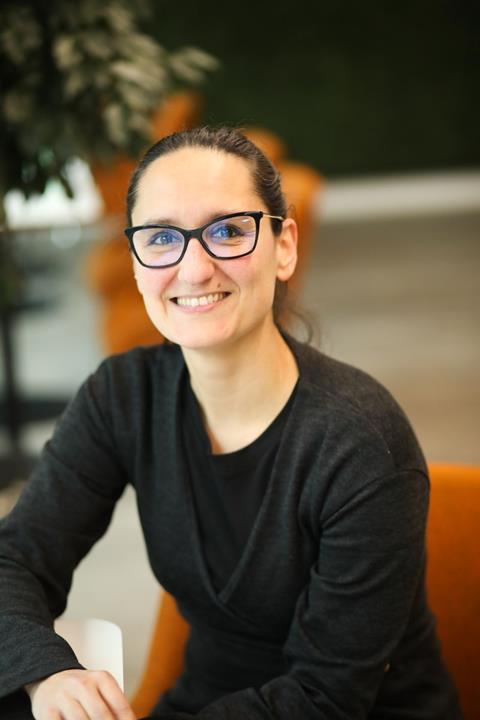
When Tania Guerra moved from Spain to London 12 years ago, she expected her stay to last six months. Her English, she admits, “was terrible”, and the plan was simple: gain experience during a difficult economic period back home, then return. Instead, she built a career – and a life.
Now an associate mechanical engineer at Chapmanbdsp, Guerra leads on complex building services projects, co-ordinating multidisciplinary teams and shaping technical delivery from concept through to construction. “I didn’t only learn engineering – I learned a language,” she says. Over more than a decade with the practice, she has progressed steadily, taking on greater responsibility and moving into leadership.
Originally trained in industrial engineering in Spain, she found the degree offered breadth but not specialism. “You study everything – the basics – but you aren’t focused on anything,” she explains. After arriving in the UK, she chose to deepen her expertise with an MSc in building services, completing four years of online learning alongside full-time work and a dissertation. “It helped me get an overall view of building services.”
Her role today is rooted in co-ordination. Designing a roof, she points out, is never just about architects and MEP engineers. “There’s structural, acoustics, landscape, maintenance – there is a lot more communication required to make it all work.” Buildings are inherently complicated, and the challenge – and satisfaction – lies in bringing competing requirements into alignment.
One of the projects that marked a turning point in her career was 120 Fleet Street. Brought in at stage 2, she stayed through to stage 4 before going on maternity leave. The project demanded technical leadership and confidence, and it was there that a director gave her the opportunity to step beyond her formal role. “I was scared, but I got the opportunity and took it,” she recalls. “If others think I can do it, why should I doubt myself?”
That willingness to step forward has defined her progression. She emphasises that growth rarely happens alone. “There are always other people you can lean on,” she says – mentors, directors and colleagues who create space for others to develop.
Returning from maternity leave was another challenge. Her daughter is now three-and-a-half, and she credits Chapmanbdsp’s flexibility – including six months part-time – with making the transition manageable.
“Flexibility is needed,” she says plainly, noting that not all employers offer the same support. Balancing professional responsibility with parenthood requires structural backing, not just personal determination.
>> Download the Women in Construction 2026 special report <<
Each project presents its own technical hurdles, but Guerra approaches them with adaptability. “Every project is different,” she says. “The best way to resolve challenges is to be flexible and reactive.” In a sector where co-ordination is constant and variables shift quickly, that mindset has proved invaluable.
As the only female associate on the engineering side of her company – with no women currently above her in that discipline – Guerra is conscious of visibility. Asked about being a role model, she responds: “I am becoming one. It is important to be able to see someone you can become.”
She believes the industry still has work to do to attract and retain women. Unconscious bias, she suggests, is often subtle. “It’s just a feeling,” she says, but companies need to treat it as “more serious than a tick-box exercise”. Education and accountability must move beyond policy into culture.
Looking back, her proudest achievement is not a single project but the life she has created. “I came to London thinking it was going to be six months, and I’ve built a whole life,” she reflects. “My colleagues became my family.” Professionally and personally, the journey has been transformative.
Her advice to women entering the built environment in the UK is direct. “Nothing is going to be given to you. If you want something, you are going to have to take it.” Hard work alone, she cautions, is not always enough. “Sometimes you think you will get noticed just by working hard, but the reality is if you want something you need to ask for it.”
For Guerra, that combination – competence, courage and the willingness to ask – is what turns opportunity into progress.