



















As pressures mount across planning, funding and delivery, Housing Forum CEO and Regen Connect advisory panellist Alex Notay outlines why the sector must step beyond traditional silos to unlock regeneration at scale. Carl Brown reports


It’s a particularly grim and overcast day in the City of London and new Housing Forum boss Alex Notay is in her office talking about her frustration over the housing crisis.
“We have had a housing crisis in this country for 50 years, there’s a reason we called the report Beyond the Permacrisis,” she says, referring to the publication by the Radix Big Tent Housing Commission, of which Notay was the principal author.
“And so, we need to do something different,” she adds with a twinkle in her eye.
When it comes to gathering fresh thinking about the housing crisis and regeneration – the latter is a “personal passion” for Notay – there are few leaders better placed to contribute right now than the Somerset-born placemaking enthusiast. She has experience of working in government, for think-tanks (including the Urban Land Institute) and in finance, through roles such as placemaking and investment director at Places for People’s fund management arm Thriving Investments.
She has also held a multitude of non-executive roles and written 30 books on the property market. Last month she was announced as a member of the advisory panel for Regen Connect – our year-long project exploring how investment in infrastructure, housing and placemaking is shaping the future of our regions.
If anyone is well placed to understand the ecosystem of housing delivery, and the tensions around funding, placemaking, regulations and viability, that person is Notay.
Her breadth of perspective suggests she is well suited to her new role as chief executive of the Housing Forum. Founded in the aftermath of the Egan review in 1999, the forum’s 150 members include a whole range of organisation types, from local authorities and registered providers to housebuilders, manufacturers, contractors, suppliers and consultants.
So, how does Notay plan to use her extensive experience and network, combined with the unique membership base of the Housing Forum, to help drive new thinking on the housing crisis?
Growing the membership base
One of Notay’s primary aims is to ensure that the Housing Forum is more visible. “My partner had worked in residential investment for 30 years and he didn’t know who the Housing Forum was when I applied for the job,” she says.
“That shouldn’t happen. The quality of the work is amazing … but it is hiding its light under a bushel.”
So how does the Notay plan to increase the forum’s influence and clout? She is not beyond using what she calls her “jazz hands” – by this she means levering her network and connections – to get the forum’s presence into rooms it hasn’t been in before. More fundamentally though, she wants to broaden the group’s membership in line with growing trends in the housing sector.
Her pitch is straightforward: the housing market of 2026 is not the housing market of 2006.
“The living sector, as it is called now, has shifted enormously in the last 20 years. While it’s still very important to have the housebuilders, RPs and local authorities as a core component of the housing market in the UK, it [the market] is exponentially so much bigger,” she says.
This means the Housing Forum is looking to other kinds of organisations to expand its membership.
“So there’s the purpose-built student accommodation [providers], but then there’s all the kind of buile-to-rent tenures – the multi-family, single family, flats and houses, all the institutional investors … private landlords,” she says.
“There’s a wave of institutional money that is coming into housing, which is relatively new for the UK – into affordable, social housing, into all those different tenures.”
And while Notay says there are lots of bodies “doing great bits for segments” of the market, there is a wider role for the Housing Forum in providing overall leadership.
There’s a wave of institutional money that’s coming into housing, which is relatively new for the UK
“There is a really unique opportunity to be the kind of umbrella body that does genuinely represent that whole housing spectrum,” she says. She likes the fact that the forum is “proactive and solutions focused”, and doesn’t “just moan”.
Notay speaks of her admiration for the National Housing Federation’s campaign ahead of the spending review last year. “Kate [Henderson, NHF chief executive] is a phenomenal campaigner and she really zeroed in on the social housing sector and the need to speak with one voice to government,” she says.
Many of the NHF’s long-term asks around rent setting and funding were subsequently adopted last summer by Keir Starmer’s administration.
But how can the Housing Forum have this NHF-style clarity of message and “speaking with one voice” when its members are drawn from such disparate parts of the sector? She admits that the Housing Forum can’t speak with one voice on every issue.
“We have to recognise there will be issues where our members have different priorities, and I’m working with the board to set out our strategic priorities and themes.
“Housebuilder members are obviously focused on new supply, and that’s great and a really important priority that we clearly will continue to work on. But a big chunk of where the market is now is about retrofit, resilience and health. Awaab’s law [for instance] is a really important thing,” she says, speaking quickly.
Notay points to the forum’s multi-disciplinary focus and its ability to draw on people with a variety of perspectives.
Using a recent Housing Forum Awaab’s Law roundtable as an example she says: “Awaab’s law is a big issue, but [to date] there have either been just registered providers in the room or just legal advisors. This was the first one where we had contractors and people in supply chains and frontline operatives doing responsive repairs.
“I think it’s about picking the right issues and the right points where we can crowdsource the breadth of knowledge from our members … the ‘one voice’ thing will be on certain issues, but nobody disputes the need to have quality homes for our customers, whatever.”
She says the forum is not trying to duplicate the work of other bodies but instead using its multi-disciplinary focus to “ask the question in a different way” and be solutions-focused.
Alex Notay: Selected CV
2026-present Chief executive, the Housing Forum
2024-present Chair, Radix Big Tent Housing Commission
2021-25 Independent commissioner, Geospatial Commission
2023-24 Non-executive director, Igloo Regeneration
2019-24 Co-chair, Creative Land Trust
2020-24 Placemaking and investment director, Thriving Investments
2018-20 Build-to-rent fund director, Thriving Investments
2016-18 Director of product and service innovation, Places for People
2012-16 Policy director, Urban Land Institute
2010-12 Vice-president, strategic programmes, Urban Land Institute
2008-09 Research director, Urban Land Institute
2007-08 Manager, programme developmenr, Urban Land Institute
2012-13 Strategy consultant, IPD
2010-11 Building retrofit, steering board member, World Economic Forum
2006-07 Business manager, regional, urban and economic policy directorate, Department for Communities and Local Government
But what about areas where members may have opposing views or interest? One obvious example is the tussles over viability and section 106.
“What we will do is have challenging and interesting conversations for our members behind closed doors, where we can surface some of those issues. And then, if I get a call from the housing minister’s office I can say, ‘look, there are divergent views but I can get our members into a room to give you a sense of those views, and I think that honesty is really important, because you can’t all agree on everything’.”
It is clear that Notay believes the Housing Forum’s cross-disciplinary focus can help to foster the type of collaboration and partnership working which she believes is sometimes lacking in the industry. “One of my bug-bears in the wider real estate industry is there are lots of very tight silos of very professional, qualified experts and we talk a really good game about collaboration and partnership but actually, in the doing, we can be quite bad at it,” she says.
The regeneration opportunity and challenges
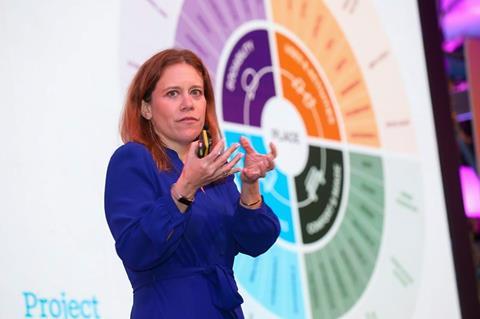
One area where collaboration is essential is regeneration. It is a space in which Notay has worked for a lot of her career and is a “personal passion”, something that is very evident from the way she talks with real enthusiasm and energy,
“At this time for our economy and growth with new towns and the opportunities that local government reform presents and the different ways that public land is going to come forward, I think regeneration is going to be an absolutely huge focus,” she says.
She stresses the need for new thinking and “being able to think at scale with a bit of vision. It’s not just going to be the ‘plug and play’ of the same old.”
So what are the barriers to regeneration that any new thinking would need to overcome?
Notay talks at length about the difficulty in aligning the needs of funders’ requirements to meet the challenge of placemaking and creating mixed-tenure developments. “The way the capital has to flow into one thing and one thing only is unhelpful,” she says.
By this she means that capital is allocated by funders for specific purposes within developments, such as for student housing or for a particular affordable housing tenure, and it is not easy to “mix that funding up” or aggregate it to create scale.
“If it’s a pension fund [for instance], they have fiduciary duties to their pension holders … It is not that they lack vision, but they have to go through processes to protect that capital.
“The types of organisations that can get comfortable with larger scale, bigger partnerships and mixes of tenure – there are relatively few of them.”
She does however reel off organisations such as Legal & General, Aviva and Pension Insurance Corporation, who she says are doing good work in this area.
Notay thinks the sector needs to better understand the needs of funders and the different types of investment, while funders themselves often do not understand the complexities of investing in housing.
“The big thing to understand is that real estate is a tiny proportion of pension funds investment, its usually under 5% of all allocations … and then housing within that is probably 1%,” she says.
“There is an educational piece, when I was in a capital-raising role I would have conversations with sophisticated investors who think, ‘we know real estate’. Then a few minutes later they would be saying, ‘what the hell is the Landlord and Tenant Act?”
New funding models
While there is a role for the Housing Forum in facilitating discussions and partnership working to aid understanding and combat the “silos”, Notay is also adamant that we need new funding models if we are to make the most of the urban regeneration opportunity.
“The housing crisis in the UK is going to need private finance. It’s going to need innovative ways of doing it, and we can’t just keep doing the same old things”, she says.
Notay is tight-lipped about the specific models she is looking at at this stage. She does however say she is interested in US-style low income housing tax credits – a model under which the government foregoes future tax revenue to incentivise institutional investment to support sub-market housing. She wants to work on developing this with those who have looked at the model in the UK, including Michael Keaveney, director of land development and acquisition at Grainger.
She says there are opportunities to think about different kinds of joint venture structures. She also points to a model being explored by L&G Affordable Homes whereby the for-profit provider invests in retrofitting a traditonal non-profit registered providers’ stock, which remains on the non-profit RP’s balance sheet, and takes a share in the rental uplift over time.
“There’s all sorts of different ways that we can look at doing that, but that does need a bit of a bit of bravery and a bit of a willingness to try new models,” she says.
More broadly there is a need for investors who are willing to be patient. “Patient capital will always tell you that regen absolutely pays, but you have to have deep enough pockets to sit and see it through for usually 20 or 30 years,” she says.
Notay stresses the need for patience and longer-term, joined-up thinking again when asked about what her message to government is. She is broadly positive about the Labour administration and says housing minister Matthew Pennycook in particular has been good at listening to the housing sector.
But more broadly she says the challenge is that politicians “want silver bullets and short-term things. My big thing is that housing is a slow game, and regeneration is even slower.
Patient capital will always tell you that regen absolutely pays, but you have to have deep enough pockets to sit and see it through for usually 20 or 30 years
“What investors need – and what communities need – is consistency, clarity and certainty. You need to know that the goalposts aren’t going to move, so you’re not going to be left with half-built buildings with second staircases that were consented that can’t be built [for example] or floodplain changes.”
In terms of specific asks, Notay calls for the establishment of a housing delivery unit, that would sit outside the multiple different departments with responsibilities for aspects of housing. It was a key recommendation of thinktank the Radix Big Tent’s housing commission, which Notay chairs. She says this unit could think outside election cycles over longer periods and she envisages it having real weight and influence like the Committee for Climate Change.
In terms of other priorities for the forum, Notay talks at length about supporting SMEs and boosting skills and training and “dealing with AI”. Interestingly she sees opportunities in the roll-out of AI and its impact on jobs to strengthen construction’s pitch to younger people.
“Our sector is one of the few sectors that we can be pretty certain – in the short term at least – is going to be relatively AI-proof, as opposed to a traditional graduate job,” she says. “What an amazing opportunity to reframe how we pitch it to young people: build your communities, build your places.”
We have been speaking for the best part of an hour. Notay is full of energy and ideas and talks quickly and excitedly about the potential of the Housing Forum and the sector going forward.
Housing is a slow game, and regeneration is even slower
So where does this enthusiasm for placemaking and regeneration come from? Not it would seem, her childhood. She pithily describes being brought up in a Somerset village which was “in the middle of nowhere … boarding schools and farms, cider and cheese”.
Like so many in the sector, Notay did not set out to work in housing. She had ambitions of joining the Foreign Office and studied international relations at the University of Sussex, eyeing a career in diplomacy.
But, after 9/11, her degree became heavily focused on global change, systems and geopolitics – themes that would later shape how she thinks about housing. She joined the civil service and worked for the Office of the Deputy Prime Minister, John Prescott’s huge department which was the forerunner of today’s MHCLG.
She worked on government finance and procurement before moving into urban policy.
“I realised that everything that I loved about nation states and diplomacy happens in cities and happens in places. I [previously] thought property and real estate was boring … but then realised placemaking and regeneration … are incredible concepts.”
She arrived in housing via public policy, urban economics and investment – and stayed because she realised that housing sits at the centre of economic growth, social justice and placemaking.
“Fundamentally, I want to do something that matters. I think there could be nothing better in this country than making a contribution towards making sure that everyone has a quality home,” she says.
We started talking about the need to “do something different” in housing, but it becomes clear after about an hour that Notay does not believe in “silver bullets” or one-off solutions that can transform delivery overnight. Instead she sees housing as a complex ecoystem made up of finance, planning, regulation, skills, land, infrastructure, tenure mix and long-term capital allocation.
The answers must lie in systems thinking, collaboration between disciplines, patient capital and long-term planning. And she wants to place the Housing Forum smack bang in the centre of it all as it seeks to achieve its mission of a “quality home for all”.

Through ongoing analysis and expert commentary, Regen Connect highlights the policies, funding streams and local priorities that matter most to the construction and development sector.
This coverage will culminate in a special report to be published at our Building the Future Live Conference in London on 7 October.
How you can get involved:
Throughout the year, our team will be gathering insight from across the sector to inform editorial features, debates and events. We welcome contributions from practitioners who want to share experience or shine a light on emerging trends.
Click here for more on the campaign
Be part of the conversation – contact us to contribute or get involved by emailing our deputy editor at dave.rogers@building.co.uk and to find the campaign on social media follow #regenconnect







No comments yet