











SJ Group CEO Sean Chiao explains why regenerative design and AI are redefining how cities are planned, built and operated — and how the built environment can deliver lasting value for people and the planet
As cities grapple with climate risk, rapid urbanisation and ageing infrastructure, the built environment is being challenged to move beyond sustainability towards a more regenerative model of growth.
Sean Chiao, group chief executive officer of SJ Group, believes this shift demands a fundamental rethink of how cities are planned, designed and operated.
In this interview with Building Design, he sets out how regenerative design and AI-driven innovation are reshaping the sector, and why global expertise must always be grounded in local context.
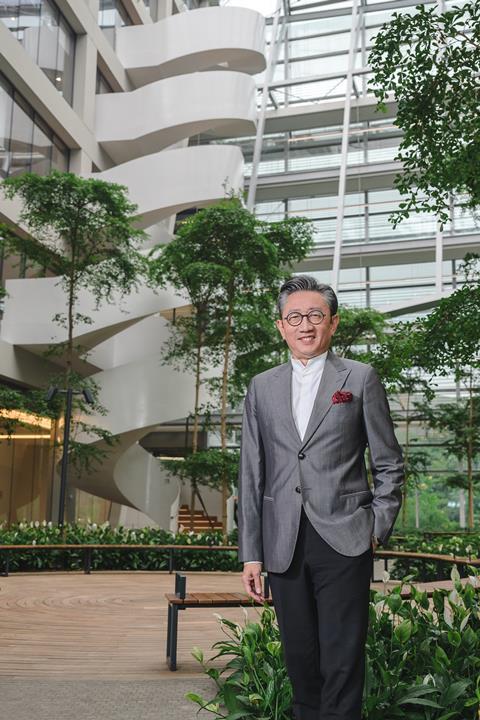
For readers less familiar with your background, who are you, and how would you describe SJ Group’s mission and role in shaping cities across Asia and beyond?
I have the privilege of leading Surbana Jurong Group (SJ Group) — a global team of 16,000 professionals across more than 40 countries, united by a shared purpose of shaping cities, infrastructure and communities that enable people to thrive.
A large part of my career has been focused on helping organisations evolve, and advancing sustainability, digitalisation and talent development so we can create impact at scale. At SJ Group, this translates into designing and delivering more regenerative, resilient and future-ready solutions.
For more than 75 years, SJ has played a key role in shaping cities across Asia and around the world. Today, our multidisciplinary expertise, spanning urban planning, design, engineering, asset management and digital innovation, allows us to combine global excellence with deep local insight.
Our mission is simple but ambitious — to create places, systems and experiences that empower people, protect the planet and build futures worth inheriting.
Many in the industry argue that we must now build on sustainability and move toward regenerative design. What does “regenerative design” mean to you, and why is this shift so important?
Regenerative design represents the next frontier of sustainable development. It’s not just about reducing harm — it’s about creating a positive, restorative impact on ecosystems and communities.
Where traditional sustainability emphasises efficiency and mitigation, regenerative design aims to restore biodiversity, renew natural systems, and strengthen social and economic resilience. This shift is essential as cities confront climate risk, population pressures and resource constraints.
For us at SJ, regenerative design is recognising the built environment as an active force of good, a catalyst that enables both nature and people to flourish together..
How is SJ Group embedding regenerative principles into its projects and consultancy work, and what does that look like in practical terms on the ground?
We see regenerative design as the natural evolution of sustainability. Many of the foundational elements of sustainability — resilience, decarbonisation, circularity, resource efficiency — remain critical.
But regenerative design pushes us further. It is designing in partnership with nature — leveraging natural processes to enhance ecological performance, integrating water, energy and material cycles holistically, and adapting development to local climates and ecosystems.
We use advanced digital tools — from emissions tracking to climate modelling — to help clients evaluate long-term value and make decisions that balance feasibility with environmental and social outcomes. Particularly in emerging markets, these tools help clients confidently invest in strategies that deliver resilience and lifestyle savings.
Can you share examples where regenerative principles — building on sustainability and nature-positive design have shaped outcomes — environmentally, socially, or economically?
We are already seeing regenerative intent shape powerful outcomes.
At our global headquarters SJ Campus in Singapore, our design integrates biodiversity preservation and climate responsive design such as elevated structures, internal courtyards and rooftop gardens to enable passive cooling and climate resilience.
As a super low energy building, it features solar PV, underfloor air distribution and high‑performance glazing — and even deploys an AI-powered energy optimisation algorithm. The result is a campus that enhances wellbeing while reducing lifecycle emissions.
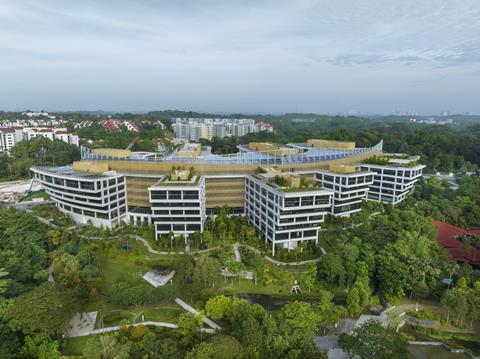
The Mandai Nature Precinct, home to Bird Paradise, Rainforest Wild ASIA and the Mandai Rainforest Resort, exemplifies nature-positive design. Its sustainability strategies, developed by Atelier Ten, an SJ company, prioritise coexistence with nature — preserving existing trees with elevated structures allowing wildlife movement, improving natural ventilation and shading, and integrating renewable energy at rooftops. Native and adaptive planting further strengthens ecological health.
These projects demonstrate how strong sustainability practices form the foundation for a regenerative future.
AI is rapidly reshaping the built environment sector. How do you see AI changing the way we plan, design, and operate cities over the next decade?
AI is unlocking an entirely new landscape of possibility across the built environment. It enhances human creativity, strengthens feasibility assessments and enables sharper, data-driven decision-making.
Over the next decade, AI will be central to rapid scenario testing and forecasting, enabling real-time optimisation of cost, carbon, resilience and user experience. It will transform how cities are designed and managed, accelerating design iterations while keeping empathy at the core of placemaking, and power digital twins that allow cities to monitor, decide and act proactively.
Used responsibly, AI becomes a powerful ally — enabling cities to respond dynamically to climate challenges, population change and resource constraints with unprecedented precision and agility.
Where is SJ Group currently deploying AI or advanced digital tools in your workflows, and what impact are you seeing in terms of design quality, efficiency, or client value?
Because SJ’s business spans the full project lifecycle, we integrate AI seamlessly across every stage — planning, design, engineering and operations.
We use digital twins, simulation tools and machine learning to predict climate impacts, optimise construction sequencing and enhance asset performance.
Horizon AI, our end-to-end AI ecosystem connects WinAI, DesignAI, DeliverAI, OperateAI, RunAI for continuous learning across all projects.
Our 24K Integrated Platform aggregates real-time telemetry and asset data for predictive maintenance and ESG reporting, and our AI-enhanced estate management system improves case intake, smart dispatch and repair success.
The 5G Integrated Command Centre by AETOS, an SJ company, fuses AI and 3D digital twins for virtual patrols and predictive risk detection.
The Design and AI (D•AI) Fab Lab, our collaboration with the Singapore University of Technology and Design, advances generative design and simulation-led workflows.
Together, these tools deliver deeper insights, faster delivery and higher design quality, enabling our teams and our clients to make decisions with clarity and confidence.

There’s often anxiety that AI could replace creativity in design. How do you balance technological innovation with the human-centric approach that’s essential to good placemaking?
Our work will always be fundamentally human. AI enhances our capabilities, but it will never replace the judgement, context and empathy essential to good design.
Our philosophy is clear — AI augments, people decide. Every AI-supported design still undergoes human review. Our AI governance framework ensures accountability, ethical standards and technical rigour from concept through deployment. This keeps human intention, curiosity and care at the heart of placemaking.
Data-driven design is becoming increasingly influential. What does AI-augmented decision-making mean for city governance and long-term asset management?
AI allows city management to shift from reaction to prediction and prevention. Through real-time data and digital twins, city leaders can anticipate challenges — from climate risks to energy demand — and act proactively.
Our digital twins use agentic orchestration, enabling systems to sense, analyse, act and learn continuously.
For long-term asset management, this means predictive maintenance, enhancing resilience, lowering lifecycle costs and more transparent, outcomes-based governance.
It’s a powerful shift toward cities that learn and improve over time.
SJ Group has been shifting towards a more sector-focused strategy. How does this model improve your ability to tackle today’s most pressing built-environment challenges?
A sector-led strategy lets us respond with deeper expertise and sharper insight.
In transport, particularly aviation, rail and metro, we strengthen our capabilities to support growth driven by urbanisation and mobility demands.
In healthcare, we combine analytics and operational intelligence to support evolving care models.
In energy, we accelerate the transition to renewables, grid modernisation and storage.
This alignment ensures we are addressing complex challenges with precision, relevance and greater impact.
Cities face overlapping crises — climate resilience, housing shortages, ageing infrastructure. Which of these priorities do you see as most urgent, and how is SJ Group responding?
These challenges reinforce one another, and climate resilience underpins them all.
Our response is integrated — embedding climate adaptation into planning and design, delivering affordable, inclusive housing supported by smart technologies, and revitalising ageing infrastructure through green retrofits and future-ready engineering.
How are you leveraging your global experience while maintaining a deep understanding of local context, particularly across diverse markets in Asia, the Middle East, and beyond?
Our strength lies in combining global best practice with deep local insight. Every market has unique cultural, regulatory and ecological nuances and understanding them is essential to delivering meaningful outcome.
In Asia, the Middle East and Australia — regions of high ambition and diverse contexts — we tailor global expertise to local realities. This ensures our solutions are not only innovative, but also practical, relevant and grounded in community needs.
What is your vision for the future of cities in 2050, and how do regenerative design and AI together position SJ Group to lead that transformation?
By 2050, the world’s most successful cities will be those that achieve a new equilibrium — cities that are regenerative, resilient, adaptive and profoundly human-centred.
Regenerative design provides the principles to guide that evolution. AI provides the intelligence to accelerate it.
Together, they form the foundation of what I call the Cognitive City — a city that learns continuously, responds dynamically and improves itself over time. A Cognitive City integrates nature-based systems with AI-driven insight, enabling urban environments to regenerate ecosystems, empower communities and optimise performance in real time.
This is the future we are building toward at SJ Group — cities that are smart and alive, but more than that, cities that restore, protect and elevate the human and natural experience for generations to come.
Postscript