












Here is a reminder of some of the features that stood out for our readers
Every week Building publishes the big-impact stories that affect companies working in the wider UK construction industry.
Here we have compiled a list of the most-read features from the past year:
How do we fund the future?
Through our Funding the Future campaign, Building has spent much of the year looking at how to bridge the gap between what the government wants to build and the money it has to pay for it.
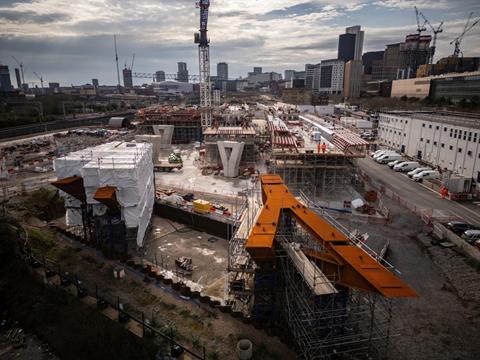
In a series of pieces on the topic, Joey Gardiner looked at whether PFI could make a comeback, dived into the weeds to look at whether it offered value for money, and examined projects like Lower Thames Crossing and Euston station for lessons onhow to fund major infrastructure.
Following the ‘sensibly cautious but promising’ infrastructure strategy in the summer, Building published its recommendations for private-public partnerships in a major report in October.
76 Upper Ground: Denys Lasdun’s 1960s South Bank vision is realised at last
The IBM Building was a cut-down version of architect Denys Lasdun’s plans for a complementary neighbour to the National Theatre on the banks of the Thames. AHMM’s recent refurbishment, which sees the building brought firmly into the 21st century, means that original vision is now complete
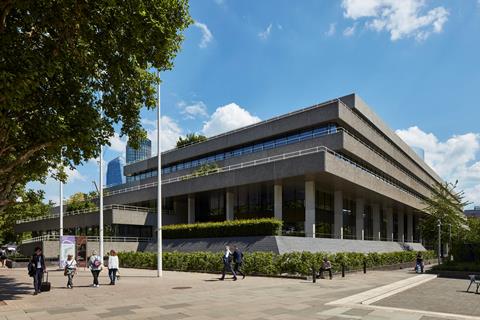
Slowly but surely, the public realm on the east side of the National Theatre has got better over the years. A once dismal service road, Stage Door Avenue, between Upper Ground and the riverside path, was improved in 2015 by banishing the theatre’s service yard at the end by the Thames. The former service yard is now a bustling restaurant area and the lorries making deliveries to the theatre and collecting rubbish have largely gone.
But the shine was dulled by the IBM building across the road from the theatre. A high brick wall and brick plinth that shouted “keep out” ran the length of Stage Door Avenue.
The building corner at the Waterloo station end of Stage Door Avenue was sullied by two car ramps; one behind the high wall up to the entrance and the other down to a subterranean car park. Office workers were banished to a pedestrian ramp between the two dedicated for cars, with protection provided by a cheap bus shelter-type canopy.
“The entrance, by any modern standards, would be deemed to be deflating,” says Simon Allford, executive director and head of studio at architect Allford Hall Monaghan Morris who was responsible for the building’s recent refurbishment. “For a building of this scale and intensity of use, there was no sense of scale, generosity, arrival or indeed clarity of where you were going in the building from here. By our modern standards of legibility and light, you were just heading towards a hole in the wall.”
Exploring the challenges of stadium building
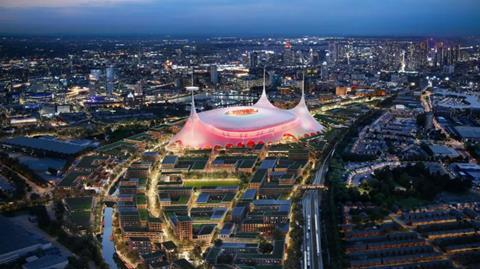
Stadiums were once again a popular topic among Building’s readers, with Manchester United’s plans to build a replacement for Old Trafford stealing the headlines. Our resident stadium watcher David Rogers looked into who might want to take on the high-profile (and potentially risky) job of building the thing, while Ben Flatman explored the tie up between the club and its chosen architect, Foster + Partners.
In its efforts to build a theatre of dreams fit for the future, United might be able to learn a thing or two from its peers in the North West. Thomas Lane took a visit to Merseyside to find out how Everton built their stadium in just five years, while Daniel Gayne explored how United’s closest rivals, Manchester City navigated their stadium expansion around a packed fixture list.
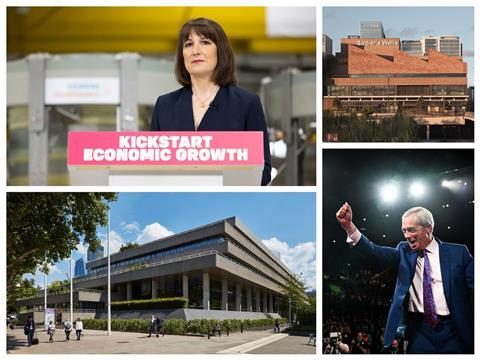
Curtain rises on Sadler’s Wells’ elegant East Bank ‘end terrace’
Last night’s opening of the new dance theatre marked another stage in the Olympic Park’s development as a cultural destination designed to lure artists and audiences out of their traditional West End comfort zone, Daniel Gayne reports
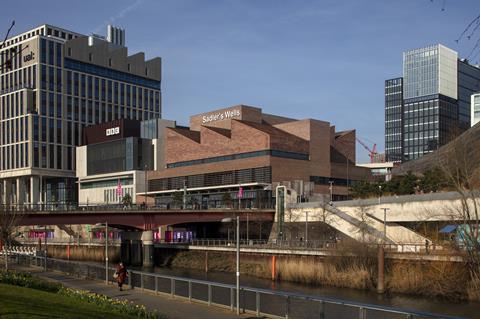
“Whatever ideas you have about dance being free, fluid, expressive and free-form, you just have to put those out of your mind,” John Tuomey tells Building, half shouting over the heavy winds blowing across Queen Elizabeth Olympic Park.
Sadler’s Wells East is O’Donnell + Tuomey’s first ever dance theatre scheme, but its opening last night was more than just a landmark for the Irish practice. It also marked an important point in the development of East Bank, a new arts quarter backed by the mayor of London’s biggest ever cultural investment which aims to drag the cultural centre of gravity in the capital eastwards.
Practice co-founder Sheila O’Donnell describes the building as an “end terrace”, alluding to its location as the last in a row of four buildings being developed at East Bank. Positioned opposite the London Aquatic Centre, at the edge of the bridge between West Ham United’s stadium and Westfield/Stratford station, there is a lot of pressure on the building to provide a warm enough welcome onto the East Bank promenade.
Clearly the architects and the dance company were aware of this responsibility – both entrances to the theatre are emblazoned with neon signs reading ”YOU ARE WELCOME” – but how do you create a building with the charisma to draw new visitors in, while meeting the technical requirements of a specialist arts venue and fitting into the deep-set infrastructure of the Olympic Park.

Watching the rise of Reform
The broader political environment in 2025 saw the governing Labour party tumble in the polls to the benefit of an insurgent Reform party.
To see what all the fuss was about, and what it could mean for the built environment, we sent Tom Lowe to the party’s conference in Birmingham in September.
There he found an “electrifying” atmosphere of confidence and excitement about cutting renewable subsidies, unleashing fossil fuel development and using tax cuts to incentivise housing development.
Designing from first principles: Inside David Kohn Architects’ Gradel Quadrangles
A major expansion for one of Oxford’s oldest colleges reimagines the logic of the quadrangle with a theatrical, landscape-first ensemble shaped by dialogue and detail
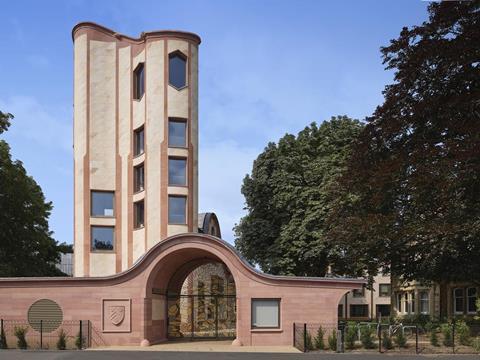
Oxford has never been short of architectural ambition. From medieval quads to 20th-century set pieces, its colleges have long used buildings to convey not just status, but evolving ideas about education and community.
Although from the street many appear as bastions of tradition, behind the cloistered walls there is a more urgent dynamic at play. Up until a few decades ago it was normal for students to live in college for their first year and then move into digs of varying degrees of insalubriousness strung out along arteries such as the Cowley Road.
That model has all but disappeared. In its place, colleges are vying to offer a more complete experience – academically rigorous, socially cohesive and spatially integrated.
The expansion of high-quality student accommodation is central to this shift. Colleges increasingly seek to house undergraduates for the full duration of their degrees, recognising the benefits this brings in terms of academic focus and community cohesion. Architecture has long been one of the key ways that colleges signal their intent. And there is something of an arms race underway when it comes to student accommodation.
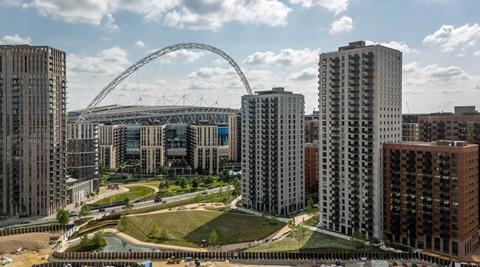
Will the BSR’s plan to clear regulatory backlog succeed
Its been a big year for the new Building Safety Regulator. An inauspicious start saw it come under criticism for regulatory delays at Gateway 2 of 11 months. The crisis led to change at the top, with ex-London fire chief Andy Roe coming in as chair, as well as a move out of the Health and Safety Executive.
Roe set out his plan to tackle the backlog of cases at our Building the Future Conference in October. The BSR, he said, would clear a backlog of 95 new-build schemes by the end of the year, while “batching out” groups of remediation applications to building inspectors in private firms. Meanwhile an innovation unit, set up in the summer, would fast-track new applications coming in, to ensure that they met the 12-week timeline for a decision.
In his November piece on the topic, Joey Gardiner looked into whether Roe’s plans had any chance of success. Initial indicators suggest the crisis is abating, but Joey’s analysis bears reading for an idea of some of the challenges Roe & co continue to face in cleaning up the mess.
Unpacking the museum: a look inside the new V&A Storehouse in Stratford
Ben Flatman visits the V&A’s new public store in east London, where the backstage world of conservation, curation and storage is placed front and centre
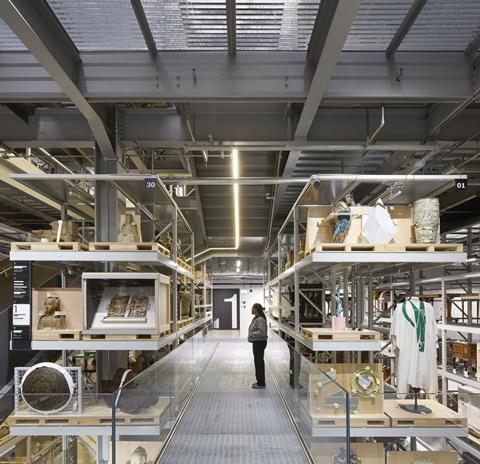
There is still an element of restricted access within the building, depending on how comfortable staff feel about it. “We don’t know how visitors are going to move around the building,” says Reeve, explaining how the V&A will evaluate the degree of access it wants to provide by monitoring how the space works.
Deeper engagement is also enabled through a new objects on-demand model. “Anyone could come and select five items,” says Diller. “You select five items and view them… that’s amazing.”
These objects are retrieved and brought to a designated viewing area. Visitors can also join daily “object encounters”, where staff present selected objects in a small group setting.
The ground floor, which was originally designed to take the weight of Olympic broadcasting lorries, has the highest load capacity. It now houses the heaviest items in the collection, but is not open to general visitors. Those requesting to view objects stored there may be brought directly to them.
What makes a good employer?
Building once again published its Good Employer Guide this year, which was accompanied by this in-depth, data-led piece unpicking the key themes. An exploration of the figures revealed interesting trends in how construction firms are today approaching hybrid working, staff benefits, wellbeing, and more.
Meanwhile, Alex Funk spoke to a panel of younger professionals to find out what they look for when applying for jobs and how employers can retain talent long-term. For even fresher insights on best practice in employment, look out for the 2026 guide in the New Year, as well as our event: Good Employer Guide Live 2026, which will take place on 5 March and the Savoy in central London.






No comments yet