


















Jobs are still being stalled by planning red tape, legislation and funding issues. A ho-hum Budget hasn’t helped contractors’ mood either but at least some are trying to look on the bright side, writes Dave Rogers, ahead of Building’s Top 150 Contractors & Housebuilders list released tomorrow.
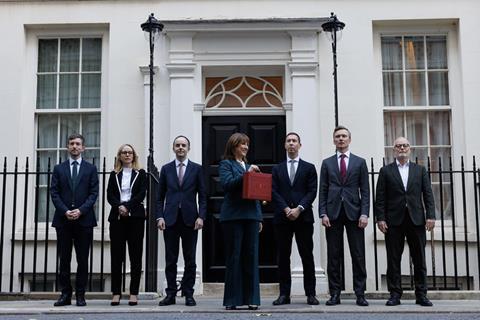
With a grim irony, another thing happened on the day of last month’s Budget.

A couple of hours after Rachel Reeves had sat down, news emerged that a company called National Timber Group, a timber supplier which employed around 1,200 people, had a turnover of £300m and had been going since 1920, had slipped into administration.
The familiar woes of liquidity issues were blamed; and the firm itself, in its accounts for 2023, said that year had seen “an extremely challenging operating environment [with] continued macroeconomic uncertainty and higher interest rate environment result[ing] in a significant reduction in demand”.
For anyone who has been following construction over the past few years, the notes in National Timber Group’s accounts are a cut-and-paste version of the sort of problems that have befallen many recently.
While there has been no collapse on the scale of ISG last year, we have seen a steady stream of headlines about firms going under, with several M&E contractors folding and an offsite specialist, which once had plans to be a £450m-turnover business, also succumbing.
At the end of August, Ardmore Construction Ltd (ACL) also went into administration after more than 50 years in business, with the firm directly blaming its demise on the extension of liability for building safety work to three decades, made under the Building Safety Act (BSA). Experts think it is inevitable more businesses will be hit by the provisions in the BSA.
An administrator’s report later said ACL was spending “huge sums of money” on lawyers dealing with remedial claims, adding that it paid out nearly £700,000 in February alone on legal bills.
Contracting has always been a tough place to make money, and outsiders continue to express surprise at the small margins firms are prepared to work for.
Wates chief executive Eoghan O’Lionaird, who joined the business in 2023, remarked last year: “It is an industry that has significant long-term challenges, something that I haven’t encountered before. One of them is that the main contractor, the one at the top of the pyramid, they don’t make any money. They take all the risk but they’re the least remunerated. It’s a curious construction.”
One of his predecessors at the firm, and a latecomer to the industry himself, says contractors need to be more fiscally disciplined and sort themselves out in the long run.
Top 150 Contractors & Housebuilders 2025

Building will tomorrow release its annual Top 150 Contractors & Housebuilders list. Our table enables you to sort the largest firms by a variety of metrics, including turnover, pre-tax profit, operating profit, margins and sectorr-specific revenue.
We will also be publishing separate lists for contractors, housebuilders and facillities management firms. We have dived into the data to uncover patterns lying in the figures and reveal which firms have had the biggest increases and falls in turnover, profit and margin. We will also publish an exclusive analyis of the housebuilding market.
Andrew Davies, who left Kier at the end of October after overseeing its return to profitability, recently said that government could only do so much to help out one of its key suppliers at a time when it was drowning in debt and its future seemed in doubt. “[They] really wanted to sort this problem out, but government doesn’t have all the levers. Their view was there was a market solution for Kier, and they were right. That’s what exactly happened: we sorted our own problems out.”
Davies says that things are looking pretty good for firms like Kier and its peers such as Balfour Beatty, Morgan Sindall and Galliford Try right now.
Contractors, certainly those working in the public sector and regulated industries such as water, have visibility of pipeline. One thing that was noticeable in the Budget was the chancellor did not row back on £120bn of government spending pledges announced over the summer in the Spending Review.
But others are less bullish. Asked what is the main difference in contracting between now and a few years ago, one exasperated chief executive says: “Things take forever [to start] at the moment.”
The question of a project’s viability has been a sore point in construction for some time now, especially in commercial development. While construction costs have gone up and up, the same cannot be said of the returns investors can expect to make on schemes.
The chief executive of the British Property Federation, Melanie Leech, is withering in her assessment of what the Budget has meant for construction. “There wasn’t a single thing said in the chancellor’s speech that wasn’t leaked in its chaotic build-up,” she says. “However, the lack of surprises doesn’t hide the disappointment that many in the development industry will feel. There was nothing introduced to alleviate acute development viability issues.”
One of the most high-profile stalled projects is down on London’s South Bank. It was called 18 Blackfriars but was renamed The Round earlier this year. Cynics might say that’s the only meaningful thing to happen on it in 2025. Enabling works were supposed to have started and a main contractor was expected in the summer. But none of these have happened. A mix of office and residential, it has a price tag of £1bn. The rumour is that it is being rethought to make the numbers stack up.
One of the main issues around viability has been institutional investors’ dwindling appetite for ploughing money into buildings over 18m high because of the BSA.
The results of a recent survey by asset manager Investec make predictable reading for those caught up in the teeth of this storm. A total of 36% of institutional investors said the introduction of the BSA had reduced appetite for building developments over 18m, while more than half, 54%, said the enhanced safety requirements of the legislation had led to extended project deadlines. A further 48% said they had affected returns.

The Building Safety Regulator (BSR) knows that what it does is crucial to the health of the market the BSA has gummed up – and the wider optics for the entire construction industry. Sort this problem out and everyone gets a boost, seems to be the view.
There is a feeling, however, that something is finally being done about the hold-ups which have ground schemes to a halt and forced some listed firms to put out profit warnings as a result.
New BSR chief executive Charlie Pugsley, who arrived like his chairman Andy Roe from the London Fire Brigade, is striking an upbeat tone about clearing the gateway 2 backlog and cutting the amount of time it takes to get approval going forward.
“Across BSR there is a confidence that projected milestones remain achievable, but rightly we remain cautiously optimistic,” he says. “We are fully committed to supporting the pace of essential construction while upholding the essential safety standard.”
Jonathan Boys, the research lead at London cost consultant Core Five, is similarly optimistic: “A consistent pattern from consultants and forecasters is to predict the beginning of a recovery in construction output, and increases to the tender price index, only to revise this down and push it out as we get closer to the date. But I think 2026 must be our year, particularly when residential picks up.”
And he adds: “As we edge closer to the next general election, the lack of progress on housebuilding will become more embarrassing and could prompt more radical reform.”
For now, the jury remains out while others worry about the pace of work on the government’s planned infrastructure spending binge.
Richard Whitehead, Aecom’s chief executive for the UK and Europe, says: “What is needed to ensure success is a shift from policy announcements to practical steps that accelerate how projects get built.” Otherwise, he says, the UK “faces slow, fragmented progress”.
Costain chief executive Alex Vaughan wants more urgency too: “This is an industry that thrives on predictability and clear decision-making from government. Long-term planning and skills investment are essential.”
Meanwhile, John Wilkinson, chief operating officer of Bam’s UK and Ireland business, says projects are too often marked by slow progress and planning red tape. Get on and build, is his message.
“We urge the government to keep momentum behind major projects and ensure infrastructure remains a priority,” he adds. “That means simpler rules, clearer regulations and fewer barriers to infrastructure projects that deliver jobs, energy and growth, backed by incentives not tax hikes.”
Allan Wilen, the economics director at forecaster Glenigan, echoes Wilkinson’s point. “It’s vital the government rapidly delivers on these commitments and does not damage already fragile investor confidence. There is a danger that the plethora of new taxes announced by the chancellor may deter private sector investment and frustrate other government objectives.”
The feeling was that in the months leading up to Reeves’s Budget, work was slowing down as contractors weighed up what to expect – much of which seemed to have been leaked beforehand. Perhaps it was fitting that the Office for Budget Responsibility accidentally published what was in it before Reeves did so herself.
Still, Leech is not the only one to complain about what was being briefed beforehand. “The construction sector and property market has been almost downing tools in the run-up to the Budget,” says Begbies Traynor partner Julie Palmer.
“Many are likely to be disappointed to see more tax rises and another hike in minimum wage. What will be difficult to avoid is the impact on the smaller businesses in [bigger firms’] supply chain; and, while the impact of the tax increases and minimum wage rises will take longer to filter through, there could be rises in restructuring, refinance or exits in the pipeline.”
There are mixed views on the minimum wage and its impact on construction, given it will be around 10% of the workforce affected. But, again, optics are important and some only see one outcome: a higher cost of jobs, which impacts viability.
Sean Keyes, chief executive of regional consultant Sutcliffe, warns: “Firms will have to make difficult choices about recruitment, pay rises will be constrained and some projects will need repricing.” Gleeds chair Richard Steer adds: “An uptick in costs for employers will do nothing to stimulate the construction jobs market, and without workers we can’t build.”
Anthony Simmons, restructuring advisory director at finance consultant FRP, says the rises “will add further pressure to construction firms’ bottom lines at a time when many are already operating on tight margins. Businesses will need to carefully assess how this impacts project viability.”
Still, it’s always good to end with some positives, even if construction’s most recent growth figures have been a bit iffy. Output, according to the ONS, was down in August but in the three summer months it was actually up, albeit by just 0.3%.
“Faster planning and more buildable sites should enable a steadier flow of new housing and regeneration schemes starting in 2026,” says Steer. It was surely no coincidence that on the morning of the Budget, the government announced that a £750m scheme to build a film studio in Buckinghamshire – turned down last year – would go ahead.
And it can’t have been a coincidence that the morning after the Budget, JPMorganChase announced it was going to build what is being billed as London’s biggest office at Canary Wharf, which the US bank says will add £10bn to the UK economy. It was such a big deal that Reeves had her say on it too.
That news, incidentally, caps a remarkable resurrection of Canary Wharf this year. It was being written off 18 months ago, a victim of post-pandemic decline, departing tenants and predictions that the financial district had lost its edge.

But footfall, leasing and visitor numbers are surging. In October, Canary Wharf Tube Station hit 105% of pre-pandemic station exits. No wonder Canary Wharf Group’s chief executive, Shobi Khan, is cock-a-hoop, saying: “2025 will be our best leasing year in over a decade. Canary Wharf has evolved into a district where commerce, culture and community thrive.”
Perhaps its resurgence is best summed up by the recent decision of the Serious Fraud Office, which had said earlier this year it was pulling the plug on a move to Canary Wharf’s Cabot Square. Last month, it reversed this and will now relocate east from its West End home of the past 13 years after all.
Canary Wharf is an important fable: strategic reinvention can revive even the most written-off districts.
And that’s good news for contractors because the jobs coming up there are huge, especially for those in fit-out where quick turnarounds are everything. Morgan Sindall chief executive John Morgan is often fond of saying that Morgan Sindall-owned Overbury, the market leader in fit-out, only needs a £4m job every day of the year to be doing well.
The kind of mega-schemes it is involved with might make the headlines, but it is the more mundane that keep it going. And how: it has made three profit upgrades already this year and is the standout performer of its listed peers in the Top 150 Contractors & Housebuilders table. A special mention should also go to Kier and Galliford Try, which both returned to the FTSE 250 list of biggest quoted firms this year.
In a broadly optimistic snap verdict on the Budget, Investec said: “While the pace of recovery may be measured in 2026, further interest rate cuts and easier planning should support positive momentum in trading, albeit likely being felt more strongly from H2 2026.”
Others, too, think some sort of recovery is bound to happen, albeit an unspectacular one. Steer, a veteran of countless boom and bust cycles, says this: “I expect 2026 to be a year of consolidation rather than a big upswing. Those developers and investors with strong balance sheets, disciplined cost control and a long-term outlook will be best placed to take advantage. For many others, the combination of tighter tax treatment and cautious buyer sentiment may encourage a more selective, risk-aware approach.”
Max Jones, director and head of construction at Lloyds, thinks confidence has been edging up since the second half of this year after inflation and interest rates began to taper.
He says: “Contractors have indicated that moderated price pressures and an ease in inflation have helped many firms to restore consistency to project planning and delivery and sparked an uptick in confidence in the second half of 2025.
“Major transport upgrades, clean energy developments, infrastructure and retrofitting projects, and regional connectivity initiatives are set to drive 2026 activity and could support a rise in confidence.”
A penultimate word must be reserved for the so-called mansion tax, which grabbed a lot of Budget headlines and will have had specialist contractors feeling nervous beforehand.
Properties valued at more than £2m are set to be hit with a surcharge of at least £2,500 from 2028. Experts think it will only rake in £400m, but the news prompted this take from prime residential mortgage lender MPowered, whose director of mortgages, Peter Stimson, noted: “For the first time ever, thousands of people have a perverse incentive to reduce the value of their homes and avoid trading up.” Maybe the government isn’t such a friend of construction after all.
Wry asides aside, this year’s Budget felt like the most important one for construction for a long time. More people seemed to be taking notice, even if it was to see whether any of what had been trailed in the months before would turn out to be true. Certainly, all the speculation meant decisions were even slower. But Iain McIlwee, chief executive of trade body the Finishes and Interiors Sector, surely speaks for many in the industry when he says the “pantomime atmosphere under which it was leaked and delivered” reinforced one thing: “We need a proper construction minister, not a junior minister with construction lost in an eye-watering portfolio.” Plus ca change.







No comments yet